Middle East Ancient Sites
The Middle East is a cradle of civilizations that boast some of the most profound and enduring legacies in the world. Its antiquity not only enriches historical knowledge but also fascinates and inspires people from across the globe. With the Spirit of Wandering, let's explore some of the most remarkable ancient sites in the Middle East.
The Pyramids of Egypt
Located in the Giza Plateau, the great Pyramids of Egypt are one of the Seven Wonders of the Ancient World. These magnificent structures were built as tombs for the country's pharaohs and their consorts during the Old and Middle Kingdom periods.
What are the unique features of the Egyptian Pyramids?
The Egyptian pyramids, primarily the Great Pyramid of Giza, are renowned for their precision and architectural prowess. The Great Pyramid withstood the passage of time and the harsh natural elements, reflecting the ingenuity of its builders. Its remarkable alignment with the cardinal points and its intricate interior structure consisting of chambers and passageways, create an awe-inspiring edifice.
Who were the creators of these pyramids?
The pyramids were crafted by skilled Egyptian labor force, not slaves as often depicted in popular culture. These builders were highly respected and well-treated, as evidenced by their close burial sites to the pyramids.
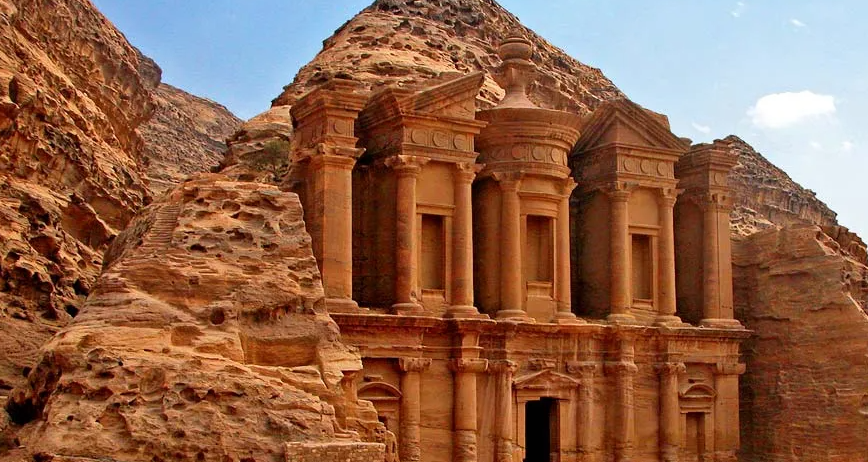
The rock city of Petra, Jordan.
Located in southwestern Jordan, Petra, the 'Rose City,' is famous for its rock-cut architecture and water conduit system.
How was Petra built and for what purpose?
Petra was the thriving capital of the Nabataean empire between 400 B.C. and A.D. 106. The city is masterfully carved into red, white, pink, and sandstone cliff faces. It hosts over 800 individual monuments, including buildings, tombs, baths, funerary halls, temples, arched gateways, and a theater. They're all meticulously chiseled from the kaleidoscopic sandstone.
How was Petra rediscovered?
Known to locals, Petra was introduced to the Western world by Swiss explorer Johann Ludwig Burckhardt in 1812.
The city of Persepolis, Iran
This ancient city, founded by Persian emperor Darius I in the 6th century BC, was the ceremonial capital of the Persian Empire during the Achaemenid era.
What made Persepolis significant?
Persepolis embodies royal palaces, monumental staircases, and exquisite reliefs representing people from all corners of the empire. While partially ruined, its remaining edifices depict a unified architectural style symbolizing the Achaemenid Dynasty's cultural diversity and inclusivity doctrine.
How was Persepolis destroyed?
In 330 BCE, Alexander the Great reportedly set the city ablaze. The ruins of this once magnificent city were subsequently covered with soil for centuries, until they were excavated in the 1930s.
The ruins of Palmyra, Syria
The city of Palmyra, once an important cultural center of the ancient world, was located in what is modern-day Syria. It was part of the Silk Road and, thus, a significant crossroads between Persia, India, China, and the Roman Empire.
What did Palmyra symbolize?
Palmyra was the embodiment of wealth and opulence, with citizens flaunting their prosperity through monumental constructions. The Temple of Baal is one such relic of Palmyra's cultural grandeur, with its tall columns and intricate carvings reflecting the fusion of Greco-Roman and Persian influences.
What is the state of Palmyra today?
Unfortunately, ongoing conflict in the region has led to severe destruction of this historical site. Despite efforts by international organizations to protect and restore it, a large part of Palmyra has been irreversibly damaged.
The ancient sites of the Middle East are more than just stone and sand — they're time capsules, capturing the spirit of ages past. Interpretation of these heritage sites complements our understanding of human civilization and helps in evaluating the contemporary world against the matrix of history. Come with a spirit of wandering, and leave with a spirit of understanding and respect for these timeless relics. The Middle East awaits your exploration!